
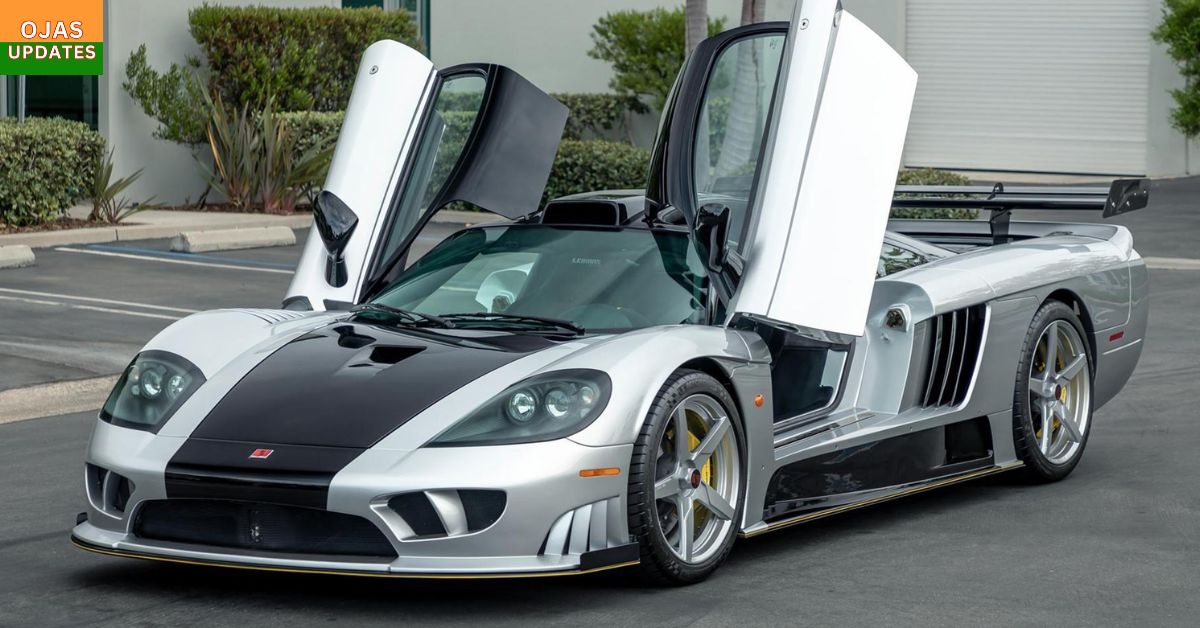
In the early 2000s, if you wanted a car that could comfortably cruise at 200 mph while turning every head on the street, you looked toward Maranello or Sant’Agata Bolognese. America was the land of the muscle car—brutish, heavy, and better at drag strips than corners. Then came Steve Saleen and the Saleen S7.
The S7 wasn’t just a fast car; it was a mid-engine, carbon-fiber middle finger to the European establishment. It proved that the U.S. could produce a world-class exotic that didn’t just compete with the likes of Ferrari and Lamborghini but, in many ways, embarrassed them.
A Design Born in a Wind Tunnel
The Saleen S7 is arguably one of the most beautiful cars ever built, but its “gills” and sweeping curves weren’t just for show. Steve Saleen, a man with a deep racing pedigree, designed the S7 with a “form follows function” philosophy.
The body is crafted entirely from carbon fiber. Its most striking feature? The aerodynamics. The S7 was engineered so that at 160 mph, it produces its own weight in downforce (roughly 2,800 lbs). Theoretically, if you could find a tunnel long enough and a driver brave enough, the S7 could be driven upside down on the ceiling.
Under the Hood: Pure American Displacement
While Europe was experimenting with high-revving V10s and V12s, Saleen went with what America does best: massive displacement.
- The Original (2000–2004): It featured a naturally aspirated 7.0L (427 cubic inch) all-aluminum V8. It produced 550 hp, allowing it to hit 60 mph in 3.3 seconds.
- The Twin Turbo (2005–2009): Saleen eventually decided “enough” wasn’t enough. They slapped two Garrett turbochargers onto that 7.0L beast, bumping the output to a staggering 750 hp and 700 lb-ft of torque.
In the mid-2000s, these numbers were alien. The Twin Turbo version could reach a top speed of 248 mph, putting it in the same rarified air as the Bugatti Veyron.
The Interior: A Pilot’s Cockpit
Stepping into an S7 is an event. The doors open in a dramatic butterfly wing fashion, revealing an asymmetrical interior. To optimize weight distribution and driver visibility, the driver’s seat is actually moved slightly toward the center of the car.
Unlike many stripped-out track cars, Saleen didn’t skip the luxury. The cabin is wrapped in Connolly leather and suede, accented with brushed aluminum. It even came with custom-fit luggage because, apparently, if you’re driving a 240 mph supercar, you still need a place for your weekend bag.
Racing Pedigree: The S7-R
You can’t talk about the S7 without mentioning the S7-R. This wasn’t a “race-inspired” road car; the road car was a “detuned” race car. The S7-R competed globally, taking home class wins at the 24 Hours of Le Mans and dominating various GT championships. It proved that the chassis wasn’t just a straight-line hero—it was a corner-carving monster.
The Legacy of a Unicorn
Production of the S7 ended in 2009 (with a very limited “LM” edition revival in 2017), but its impact remains. It paved the way for the modern American hypercar scene, setting the stage for cars like the Ford GT and the Hennessey Venom.
Today, the Saleen S7 is a highly coveted collector’s item. It represents a specific moment in time when a small team in California decided to stop tuning Mustangs and build the fastest car in the world. It was raw, it was manual (a 6-speed stick shift!), and it had no electronic stability control. It was a driver’s car in the purest, most terrifyingly beautiful sense.
Quick Specs at a Glance
| Feature | Saleen S7 Twin Turbo |
| Engine | 7.0L Twin-Turbocharged V8 |
| Horsepower | 750 hp |
| 0–60 mph | 2.8 Seconds |
| Top Speed | 248 mph (400 km/h) |
| Body Material | Autoclaved Carbon Fiber |
| Transmission | 6-Speed Manual |
The Saleen S7 remains a testament to American ambition. In a world of hybrid motors and paddle shifters, the S7 stands as a reminder of what happens when you combine a massive V8, a lightweight carbon shell, and a “never-say-die” attitude. It isn’t just a car; it’s an American legend.