
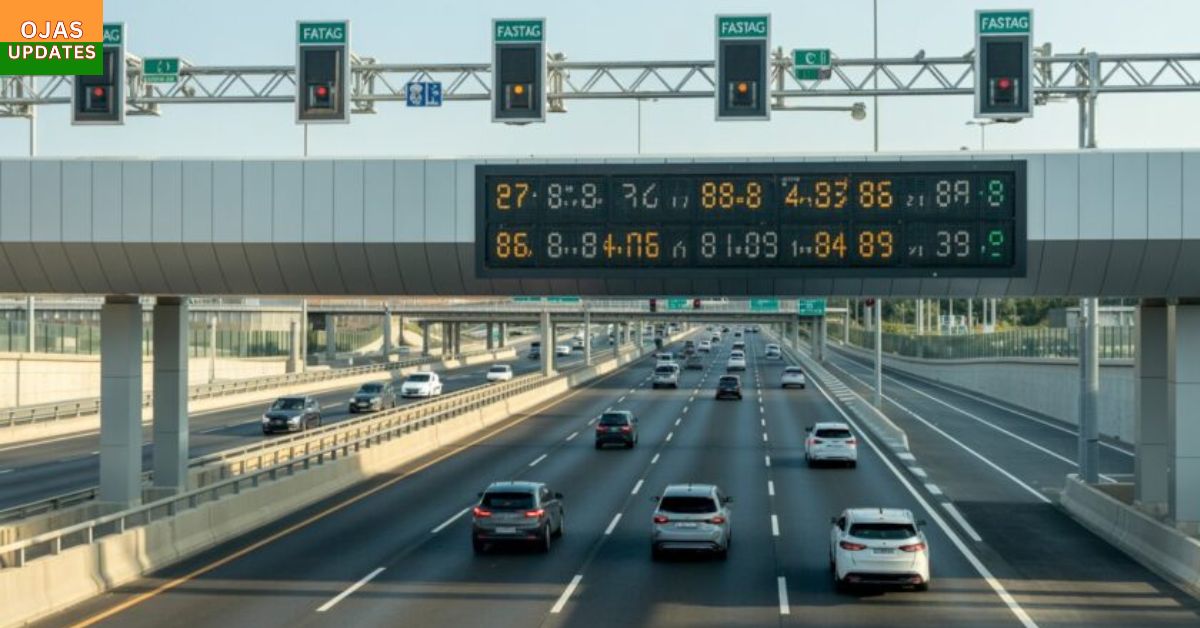
India’s infrastructure sector is undergoing a massive digital transformation. For years, the daily commute on national highways was synonymous with long queues, fuel wastage, and massive economic losses at toll plazas. While the introduction of FASTag significantly reduced waiting times, the government and highway authorities have taken a giant leap forward with the deployment of India’s first barrier-free, Multi-Lane Free Flow (MLFF) tolling system. This technological marvel promises a paradigm shift in how millions of vehicles traverse the nation’s highways.
What is the Multi-Lane Free Flow (MLFF) System?
In May 2026, The National Highways Authority of India (NHAI) operationalized the country’s first barrier-free MLFF tolling system at the Chorayasi Toll Plaza on the Surat–Bharuch stretch of National Highway-48 in Gujarat.
Unlike conventional toll booths where vehicles must slow down or come to a complete halt, barrier-free tolling utilizes an advanced, sensor-based setup featuring overhead gantries. As a vehicle passes under these structures at highway speeds, the system captures the vehicle’s registration details and deducts the fare directly from a linked digital account—all without requiring the vehicle to stop.
Did You Know? > The Chorayasi Toll Plaza is one of the top 10 toll plazas in India by user fee collection, making it a highly strategic pilot location for testing heavy highway traffic flows.
How the System Operates: Behind the Technology
The architecture of the new MLFF framework integrates a combination of artificial intelligence and high-performance hardware to ensure security and accuracy:
- High-Definition ANPR Cameras: The system uses Automatic Number Plate Recognition (ANPR) cameras that can capture both front and rear registration plates of vehicles moving at highway speeds.
- RFID Technology: Integrated FASTag readers work in tandem with the ANPR cameras to ensure that the electronic toll collection (ETC) account linked to the vehicle is correctly identified.
- Centralized Database Integration: The data is cross-referenced with the centralized VAHAN database to verify vehicle classification—differentiating between a two-wheeler, car, or multi-axle truck.
Major Benefits of the New Infrastructure
The implementation of open-road tolling offers immediate and long-term benefits for the environment and the economy:
- Uninterrupted Travel: Drivers no longer need to brake or stop, resulting in a much smoother and faster highway experience. Union Minister for Road Transport and Highways Nitin Gadkari highlighted that the aim is to allow cars to pass through toll points at speeds of up to $80\text{ km/h}$.
- Reduced Carbon Footprint: Eliminating stop-and-go traffic cuts down vehicular emissions and saves millions of liters of fuel every year.
- Better Logistics Efficiency: Faster movement of goods lowers transportation costs, directly benefiting consumers and strengthening the “Ease of Doing Business.”
Enforcement and the Road Ahead
To prevent revenue leakage in a system without physical gates, NHAI has introduced strict digital enforcement measures:
- Sufficient Balance Requirement: Users are urged to maintain an active balance in their FASTag accounts.
- Electronic Notices (E-Notices): If a vehicle crosses without a valid or funded tag, an e-notice is issued, giving the user a 72-hour window to pay via the designated portal.
- Penalties for Non-Payment: Failure to pay within 72 hours results in a penalty of up to twice the normal user fee. Furthermore, unpaid dues can lead to the denial of regional transport services, such as fitness certificate renewals or ownership transfers.
Following this launch on NH-48, the government plans to scale barrier-less tolling to over 1,000 toll plazas across India by the end of 2026. This move solidifies India’s position as a global leader in intelligent transport systems.