
For generations, the recipe for a Ferrari was etched in stone: an impossibly low silhouette, an engine note that could shatter glass, and a volatile, emotional spirit that defied all logical financial reasoning. You didn’t buy a Ferrari because it was sensible; you bought it because it made your chest ache.
In a glamorous world premiere in Rome, Ferrari pulled the silk sheet off the Luce (Italian for “Light”). The fallout was immediate, spectacular, and fundamentally divisive. It wasn’t just that Ferrari had built an electric vehicle. It was how they built it. Within 24 hours of the debut, Ferrari’s stock price stumbled by as much as 8% as purists, traditional collectors, and automotive journalists melted down across social media.
Ferrari’s first-ever EV isn’t just a departure from tradition—it is a total, unapologetic rewriting of the Maranello mythos.
The Jony Ive Effect: An “Apple Mouse” on Wheels?
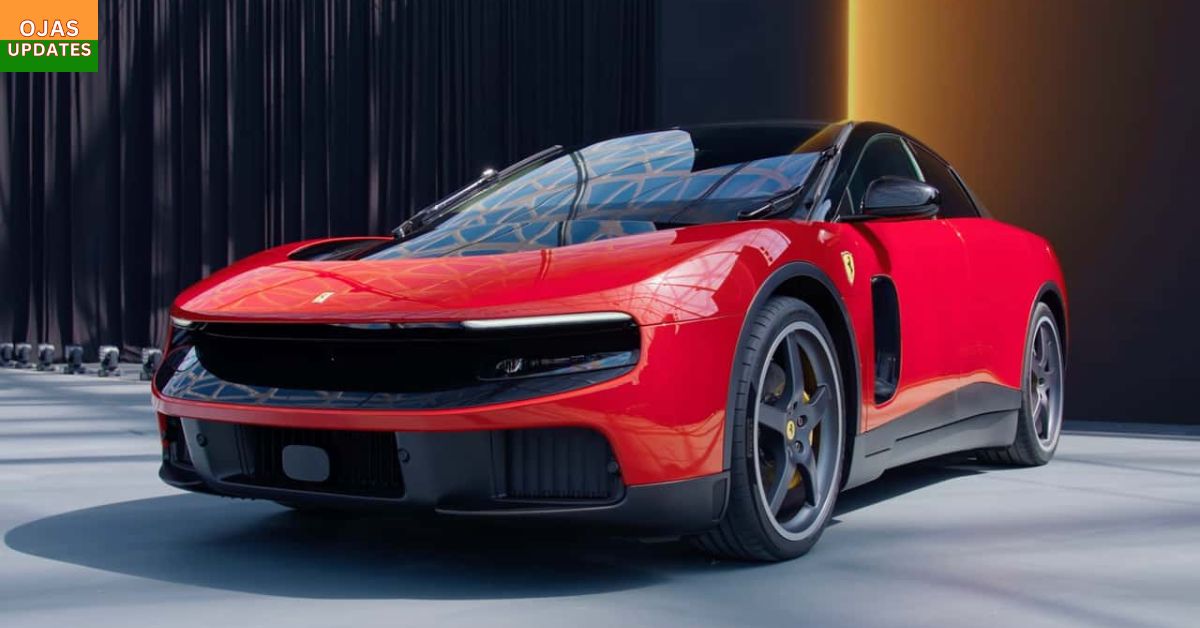
Much of the raging controversy centers around the car’s radical aesthetic. To design the Luce, Ferrari bypassed its usual styling tropes and handed a blank check to LoveFrom, the creative firm helmed by legendary former Apple design chief Sir Jony Ive and Marc Newson.
The result of this tech-meets-supercar partnership is a five-seat, four-door liftback sedan that stretches longer and sits lower than the Purosangue SUV. It trades hyper-aggressive splitters and cooling vents for clean, continuous aluminum panels and a sweeping cab-forward stance.
Critically, the internet was unmerciful. Detractors immediately flooded social media with memes, comparing the smooth, minimalist shape to everything from premium cordless vacuum cleaners to Apple’s infamous Magic Mouse. Former Ferrari chairman Luca di Montezemolo publicly lamented that the vehicle risked “the destruction of a myth,” while Italy’s transport minister bluntly stated it looked like anything but a Prancing Horse.
Anti-Screen: The Ultimate Luxury Rebellion
While the exterior screams Silicon Valley, the interior is where Jony Ive’s signature genius claws back some respect from critics. In a world where premium EVs are dominated by giant, characterless televisions slapped onto the dashboard, the Luce does something delightfully rebellious: it almost entirely bans large touchscreens.
Instead, the cabin is a breathtaking homage to tactile mechanical engineering.
- The Steering Assembly: Machined from a single piece of recycled aluminum, the wheel houses true, physical switchgear rather than finicky haptic touchpads.
- The Moving Binnacle: The entire instrument cluster moves with the steering wheel. It features overlapping Samsung OLED displays set behind precision-machined glass lenses and aluminum bezels, mimicking high-end Swiss horology.
- The Launch Control Pull: To activate Launch Mode, the driver reaches upward to toggle a heavy, physical mechanical pull-handle integrated into the overhead console.
- The Key: Even the key is a piece of art—crafted from Corning Fusion5 glass and utilizing a custom E Ink display.
The Numbers Are Biblical (But Are They Enough?)
Beneath the polarizing LoveFrom bodywork lies a mechanical powerhouse assembled in Maranello’s state-of-the-art E-Building. The Luce utilizes a four-motor, all-wheel-drive architecture fed by a 122 kWh battery pack.
The specifications are objectively staggering:
| Specification | Metric Value | Imperial Value |
| Total Power | $1,036 \text{ hp}$ ($772 \text{ kW}$) | $1,036 \text{ hp}$ |
| 0–100 km/h (0–62 mph) | 2.5 seconds | 2.5 seconds |
| Top Speed | $310 \text{ km/h}$ | $193 \text{ mph}$ |
| Target Range | $530 \text{ km}$ (WLTP) | ~329 miles |
Yet, even here, controversy brews. Hardcore petrolheads have pointed out that while a $640,000 (€550,000) price tag buys you a blistering 2.5-second sprint, family electric cars costing a fraction of the price can practically match it. Furthermore, a curb weight ticking the scales close to $5,000 \text{ lbs}$ ($2,260 \text{ kg}$) means Ferrari had to rely heavily on advanced torque vectoring, active anti-roll suspension, and massive 24-inch rear wheels just to maintain its iconic cornering agility.
To combat the silence of electrification, Ferrari avoided artificial, simulated engine notes. Instead, they patented an acoustic system that captures the natural, mechanical vibrations of the electric motors and amplifies them into a distinct, raw hum inside and outside the cabin.
The Loyalty Loophole
The drama has even spilled over into Ferrari’s notoriously secretive dealership ecosystem. Because allocation lists for limited-edition Ferrari hypercars are highly guarded, a rumor spread like wildfire that purchasing a Luce would grant wealthy buyers massive “loyalty credits,” shooting them to the front of the line for future petrol-burning supercars.
The speculation grew so intense that Maranello had to issue strict orders to global dealers, forbidding them from bundling the Luce or using it as a loyalty bargaining chip. Ferrari wants people to buy the Luce because they genuinely love it—not as a stepping stone to buy a V12.
The Verdict
The Ferrari Luce asks the automotive world to make a profound psychological pivot. For a century, Ferrari was defined by mechanical chaos—the heat of an engine, the smell of fuel, the violence of an exhaust note. The Luce replaces that primal instinct with calculated, serene, architectural perfection.
It may not look or sound like the Ferraris of the past, but true innovation rarely pleases the traditionalists. Whether the Luce is a brilliant stroke of evolutionary genius or an expensive misstep remains to be seen—but one thing is certain: Maranello has never built anything that caused a stir quite like this.