
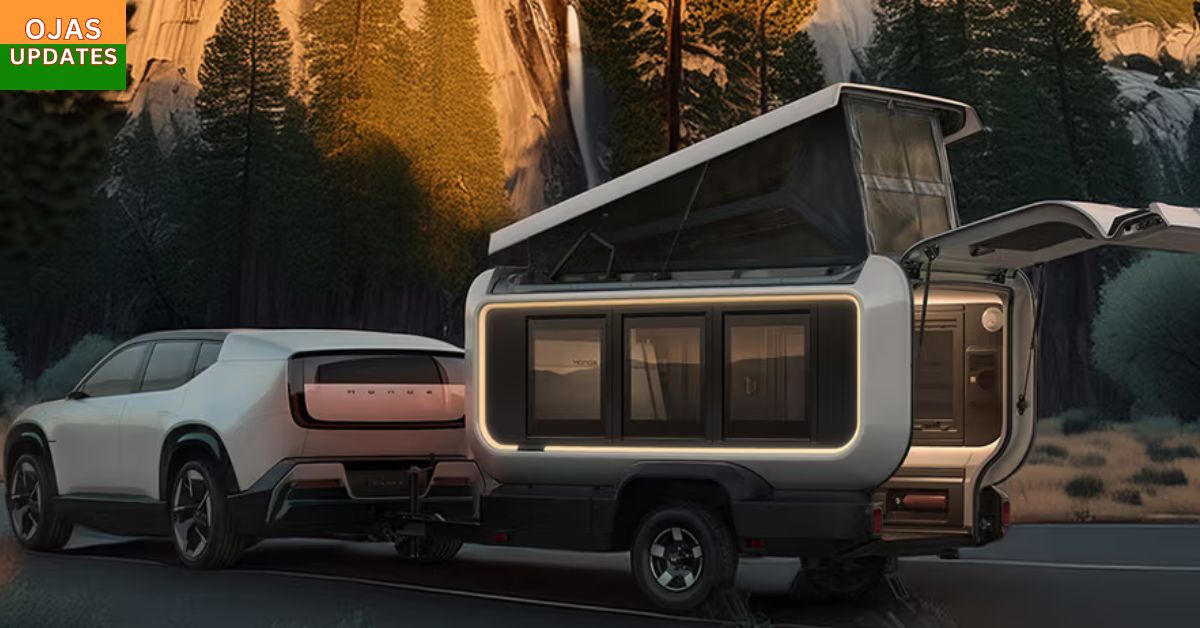
Camping has traditionally been associated with bulky trailers and large tow vehicles, often limiting participation to those with big SUVs or trucks. Honda is challenging that notion with the Base Station Prototype, revealed in January 2026 at its U.S. headquarters. This innovative camper redefines what compact outdoor living can look like, offering a lightweight, modular, and tech-savvy solution for modern adventurers.
🌟 What Makes the Base Station Different?
Honda’s Base Station Prototype is not just another camper—it’s a compact revolution.
- Towable by compact SUVs and EVs: Unlike traditional campers requiring heavy-duty vehicles, the Base Station can be pulled by smaller crossovers with towing capacities around 1,500 pounds.
- Lightweight construction: Designed to minimize strain on vehicles while maximizing usability.
- Modular design: Flexible interior layouts allow customization for families, couples, or solo travelers.
- Smart technology integration: Features like connected lighting, climate control, and entertainment systems enhance convenience.
- Clever packaging: Efficient use of space ensures comfort without excess bulk.
🏕️ Comfort Meets Accessibility
Honda’s vision is to democratize camping, making it accessible to a wider audience.
- Compact yet spacious: Despite its smaller footprint, the Base Station offers comfortable sleeping arrangements and living space.
- Family-friendly: Perfect for young families who want to explore without investing in large tow vehicles.
- Eco-conscious: Designed with future EV compatibility in mind, aligning with Honda’s sustainability goals.
⚡ Technology and Innovation
The Base Station Prototype isn’t just about size—it’s about smart camping.
- Connected systems: Users can control lighting, temperature, and entertainment via mobile apps.
- Energy efficiency: Lightweight materials and smart power management reduce environmental impact.
- Future-ready design: Anticipates integration with EVs, ensuring relevance in a rapidly electrifying automotive landscape.
🆚 Comparison: Base Station vs. Traditional Campers
| Feature | Honda Base Station Prototype | Traditional Camper |
|---|---|---|
| Tow Vehicle Requirement | Compact SUV / EV | Large SUV / Truck |
| Weight | Lightweight (~1,500 lbs) | Heavy (3,000+ lbs) |
| Design | Modular, tech-integrated | Fixed layouts |
| Accessibility | Affordable, family-friendly | Higher cost, limited audience |
| Sustainability | EV-compatible, efficient | Conventional fuel focus |
⚖️ Market Impact
Honda’s Base Station Prototype could reshape the camping industry:
- Expanding the market: By lowering entry barriers, more families can participate in outdoor adventures.
- Competing with rivals: Models like Airstream’s Basecamp exist, but Honda aims to offer a more affordable and functional alternative.
- Boosting compact SUV appeal: Owners of vehicles like the Honda CR-V or HR-V gain new lifestyle possibilities.
🌍 Challenges and Considerations
While promising, the Base Station faces hurdles:
- Durability testing: Ensuring lightweight materials withstand rugged use.
- Pricing strategy: Must remain affordable to achieve mass adoption.
- Consumer education: Convincing buyers that compact campers can deliver comfort comparable to larger models.
🔮 Conclusion
The Honda Base Station Prototype is more than a camper—it’s a statement of innovation and inclusivity. By combining lightweight engineering, modular design, and smart technology, Honda is redefining compact camping for a new generation.
For families, adventurers, and eco-conscious travelers, the Base Station represents a future where camping is not limited by vehicle size or budget. If Honda brings this prototype to production, it could become a game-changer in the outdoor adventure market, making compact camping mainstream.