
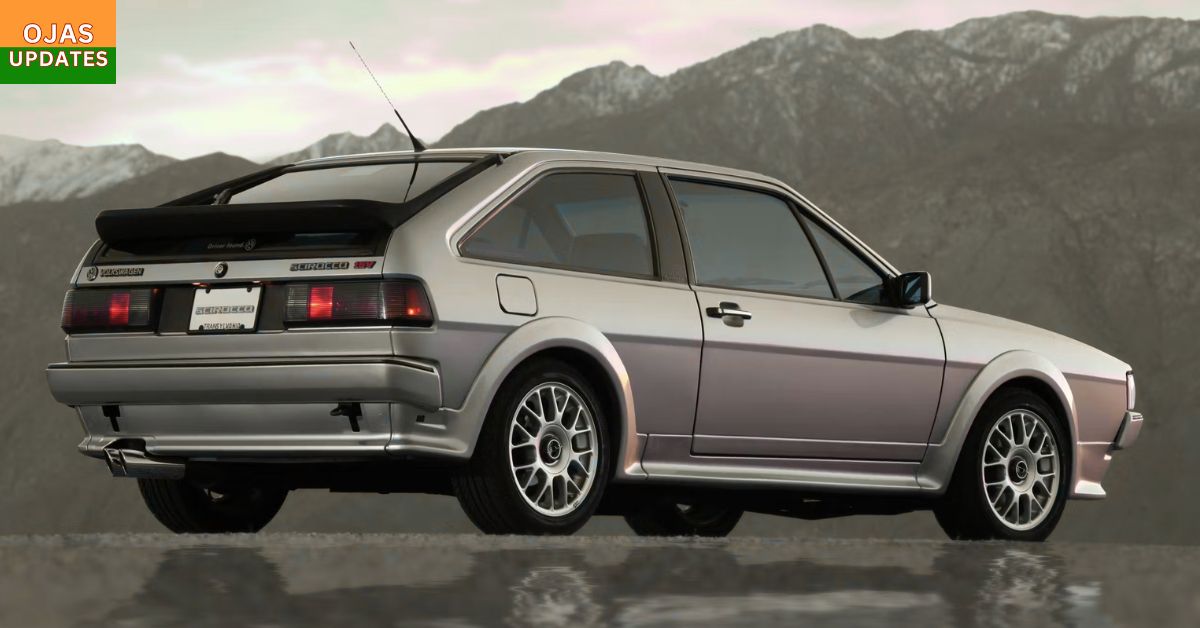
Named after a fierce, hot Mediterranean wind blowing from the Sahara, the Volkswagen Scirocco was never designed to be a quiet vehicle. Over three distinct generations spanning more than four decades, this sharp-edged coupe stood out as a bold alternative for drivers who wanted the bulletproof reliability of a VW Golf but refused to blend into a sea of sensible family hatchbacks.
Though production wrapped in 2017, The Scirocco continues to capture the imaginations of collectors and tuners alike. To understand why it remains an absolute icon of the performance-compact world, we have to look back at the distinct eras that shaped the “Rocco.”
Mk1 (1974–1981): The Italian-Styled Trailblazer
To truly understand most Sciroccos, you have to realize that it actually paved the way for the vehicle everyone associates with hot-hatch history: the Golf GTI.
In the early 1970s, Volkswagen needed a modern, front-wheel-drive successor to the beautiful but aging air-cooled Karmann Ghia. Volkswagen turned to legendary automotive designer Giorgetto Giugiaro at Italdesign to pen a sharp, aggressive, wedge-shaped coupe.
Built alongside the Golf but launched six months ahead of it to test the new platform’s market reception, the Mk1 Scirocco was an instant smash.
- The Staggering Sales: Volkswagen managed to sell over 500,000 units of the first-generation car globally.
- The Historical Footnote: While the iconic Golf GTI gets all the historical credit, it was actually the 1976 Scirocco GTi that debuted VW’s high-revving, 110-horsepower fuel-injected engine first.
Weighing just 800 kg, the Mk1 was light, nimble, and beautifully proportioned. Most Mk1 models were characterized by their iconic quad-round or crisp rectangular headlights, depending on the trim level.
Mk2 (1981–1992): The 1980s Space-Age Evolution
When it came time for a refresh, Volkswagen decided to handle the styling in-house at Wolfsburg. The result was the Mk2 Scirocco (Typ 53B), a car that looked less like a traditional hatchback and more like a sleek spaceship.
The design was stretched, featuring a heavily elongated wedge profile, softer lines, and a distinct spoiler mounted squarely across the glass of the rear window. It was highly aerodynamic, boasting a 10% reduction in drag compared to the original Giugiaro version.
For most 1980s enthusiasts, the ultimate iteration was the Scirocco GTX 1.8 16V. Pumping out 139 horsepower, it became the first Scirocco to breach the 200 km/h mark. Coupled with its bold body kit, black wheel arch extensions, and iconic teardrop alloy wheels, it looked ready to star in a sci-fi flick.
By the time production ceased in 1992 to make room for the more expensive Corrado, Karmann had built 291,497 units of the Mk2.
Mk3 (2008–2017): The Widebody Modern Masterpiece
After a grueling 16-year hiatus, Volkswagen sent shockwaves through the automotive community by reviving the nameplate at the 2008 Geneva Motor Show.
The Mk3 Scirocco was unlike anything else in the Volkswagen lineup. Built on the PQ35 platform, the third-generation model featured an aggressively low roofline, heavily flared rear arches, and a menacing front grille that gave it an incredibly squat, muscular road presence. It wasn’t a retro throwback; it was a pure, forward-looking sports coupe.
The Peak of Performance: The Scirocco R
For the absolute majority of modern car fans, the definitive Scirocco is the Scirocco R.
While standard models utilized the 1.4-litre and 2.0-litre TSI engines, the hardcore ‘R’ packed a modified EA113 2.0-litre turbocharged engine generating a roaring 276 horsepower (280 PS) in its final facelift form.
With giant front air intakes, a custom rear diffuser, dual chrome exhaust tips, and iconic 19-inch Talladega alloy wheels, the Scirocco R was a front-wheel-drive weapon capable of out-handling and out-styling contemporary sports cars.
Why Is the Scirocco So Revered Today?
The tragic catch of the modern Scirocco’s success is that Volkswagen chose never to sell the third-generation model in North America, fearing it would cannibalize sales of the GTI. This omission only added to the car’s mystique, making it a forbidden fruit for car enthusiasts across the Atlantic.
Ultimately, shifting consumer tastes toward compact crossovers and SUVs led to the Scirocco’s retirement. But whether you are looking at the razor-sharp Giugiaro lines of the 1970s originals or the wide-hipped, road-hugging silhouette of the 2010s ‘R’ models, the Scirocco represents a golden era of risk-taking at Volkswagen. It remains one of the most striking, driver-focused coupes to ever roll off a production line.