
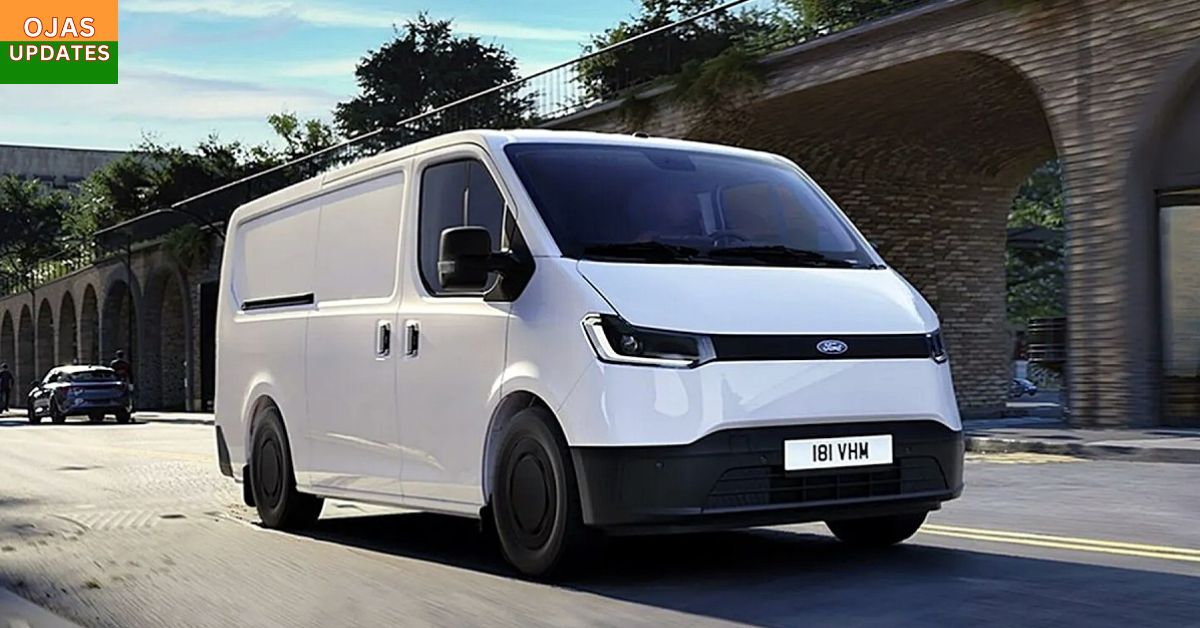
In the rapidly evolving world of last-mile delivery, the “Goldilocks” solution—a vehicle neither too large for cramped alleyways nor too small for a meaningful payload—has been hard to find. Ford Pro has officially answered the call with the debut of the Transit City, a dedicated all-electric compact van designed specifically to dominate the urban landscape.
Revealed in late March 2026, The Transit City isn’t just another trim level; it is a ground-up commitment to zero-emission city work, slotting perfectly between the nimble E-Transit Courier and the heavy-duty E-Transit Custom.
Designed for the “Stop-and-Go” Reality
Urban couriers and service providers face a unique set of challenges: low-emission zone restrictions, high-frequency stops (often up to 200 times a day), and the constant struggle of navigating tight streets. The Transit City addresses these with a focused, “no-nonsense” engineering approach.
Ford’s data from thousands of connected vehicles showed a surprising trend: 90% of urban vans travel less than 110 km (approx. 68 miles) per day. Instead of chasing massive, heavy batteries that eat into payload capacity, Ford equipped the Transit City with a right-sized 56 kWh Lithium Iron Phosphate (LFP) battery.
- Target Range: Up to 254 km (158 miles) on a full charge.
- The Benefit: This is more than double the average daily requirement, providing a comfortable safety buffer for HVAC use and heavy loads without the cost or weight of a 100-kWh pack.
Power and Efficiency Where It Counts
Under the hood—or rather, under the floor—is a 110 kW (147 hp) front-mounted motor. While it won’t be breaking land speed records, it is tuned for the immediate torque needed to merge into city traffic with a full load.
Charging Specs:
To keep downtime to a minimum, the Transit City supports:
- 11 kW AC Charging: 10–100% in roughly 5 hours (ideal for overnight depot charging).
- 87 kW DC Fast Charging: 10–80% in about 33 minutes.
- Quick Boost: Just 10 minutes on a fast charger can add 50 km of range—enough to finish that final afternoon loop.
Built Like a Tank, Configured Like a Tool
Ford’s “Transit Tough” reputation is alive and well here. The Transit City underwent “torture testing” designed to simulate 10 years of extreme use, with extra reinforcement on high-traffic areas like door hinges and seat bolsters.
Businesses can choose from three distinct configurations:
- L1H1 Panel Van: The compact specialist, capable of carrying three Euro pallets despite its small footprint.
- L2H2 Panel Van: The “High Roof” hero, offering a massive 8.5 cubic meters of volume and a load length exceeding 3 meters.
- Chassis Cab: A first for Ford Pro in this segment, allowing for bespoke conversions like refrigerated units or specialized municipal tippers.
With a maximum payload of up to 1,275 kg, the Transit City punches well above its weight class.
A Cabin Built for the Modern Driver
The interior of the Transit City is a blend of rugged durability and modern tech. Recognizing that drivers spend hours in these seats, Ford has included a 12-inch touchscreen as standard, featuring SYNC 4, Apple CarPlay, and Android Auto.
More importantly, the van introduces a One-Pedal Drive mode specifically tuned for urban congestion. This allows drivers to accelerate and decelerate using only the throttle, significantly reducing leg fatigue during multi-drop routes while maximizing energy recuperation.
Standard Safety Suite:
- Pre-Collision Assist with Automatic Emergency Braking
- Lane-Keeping System
- Rear-View Camera and Parking Sensors
- Adaptive Cruise Control
The Bottom Line: Cutting Costs, Not Corners
Perhaps the most compelling argument for the Transit City is the financial one. Ford Pro estimates that maintenance costs will be 40% lower than an equivalent diesel van, thanks to fewer moving parts and a generous two-year/40,000 km service interval.
By utilizing LFP battery chemistry—which is generally more durable and less expensive than traditional Nickel-Cobalt-Manganese (NCM) cells—Ford is aiming for a price point that makes the transition to electric a “no-brainer” for small business owners and fleet managers alike.